
Reconciliation
Not as simple as it might sound

I previously talked about my personal efforts of Reconciliation with mentors, Indigenous Peoples and my unconscious biases underlying this issue. You can read those posts here and here. In this post, I want to talk about the whole idea of reconciling; what does it mean to reconcile, and how should one go about it in all the situations where it is called for? I hope we’ll all learn a bit more about this many faceted topic and be empowered to act in good ways when we engage in the process.
The other day, I was watching an episode of one of my favourite TV shows, Northern Exposure, and in one scene, Dr. Fleischman apologized to Ms O’Connel for misconstruing what he thought was an action she had deliberately taken to keep him from attending a town social event.
After speaking with others in the town, he eventually came to realize that she hadn’t intentionally done any such thing and that he had acted in a bad way by accusing her of doing so.
So he apologized.
Said he was out of line and was sorry for unjustly accusing her of that action.
She accepted his apology.
And they were reconciled.
That’s a very simple act of reconciliation, but it doesn’t always work so nicely. Sometimes an apology is sufficient and sometimes it is actually an insult if that is all that is being offered.
In more serious cases, the party offering the apology may also need to make amends for the harm caused.
And therein lies the difficulty. So let’s look at the topic of reconciliation and see how, depending on the situation, we might do it in a good way.
If you’ve read any of my previous posts, you know I always like to start out unpacking the origins of the word itself.
So…
Etymology
Reconciliation can be broken into 2 distinct parts; the prefix re- and the body, conciliate. We’ll start with conciliation.
If you’re a TL;DR kinda person, this section is quite detailed so jump down to the section with bullets and bolded sentences to get its main takeaways.
From Etymonline:
We’ll start with the verb form:
"overcome distrust or hostility of by soothing and pacifying," 1540s, from Latin conciliatus, past participle of conciliare "to bring together, unite in feelings, make friendly," from concilium "a meeting, a gathering of people," from assimilated form of com "together, together with" (see com-) + PIE *kal-yo-, suffixed form of root *kele- (2) "to shout" (the notion is of "a calling together"). Related: Conciliated; conciliating; conciliary. The earlier verb was Middle English concile "to reconcile" (late 14c.).
Here’s the noun form:
1540s, "act of converting from jealousy or suspicion and gaining favor or good will," from French conciliation, from Latin conciliationem (nominative conciliatio) "a connection, union, bond," figuratively "a making friendly, gaining over." (see conciliate).
And here’s the adjectival form:
"tending to conciliate," 1570s, from conciliate + -ory. Related: Conciliator "one who conciliates" (1570s). Conciliative "designed to produce conciliation" is attested from 1817.
And what happens when we add the prefix re- to it?
mid-14c., reconcilen, transitive, in reference to persons, "to restore to union and friendship after estrangement or variance," also of God or Christ, "restore (mankind, sinners) to favor or grace," from Old French reconcilier (12c.) and directly from Latin reconciliare "to bring together again; regain; win over again, conciliate," from re- "again" (see re-) + conciliare "make friendly" (see conciliate).
Reflexive sense of "become reconciled, reconcile oneself" is from late 14c. Meaning "to make (discordant facts or statements) consistent, rid of apparent discrepancies" is from 1550s. Mental sense of "make (actions, facts, conditions, etc.) consistent with each other in one's mind" is from 1620s. Sense of "bring into acquiescence or quiet submission" (with to) is from c. 1600. Related: Reconciled; reconciling.
mid-14c., reconciliacioun, "renewal of friendship after disagreement or enmity, action of reaching accord with an adversary or one estranged" (originally especially of God and sinners), from Old French reconciliacion (14c.) and directly from Latin reconciliationem (nominative reconciliatio) "a re-establishing, a reconciling," noun of action from past-participle stem of reconciliare (see reconcile).
From 1729 as "act of harmonizing or making consistent." Other early noun forms included reconcilement (mid-15c.), reconciling (late 14c.).
And lastly, we can also add another prefix, ir- to get
1640s, from ir- "not, opposite of" + reconciliation. Irreconcilement in the same sense is from 1737.
And here are common usages of Reconciliation from the Cambridge Dictionary.
a situation in which two people or groups of people become friendly again after they have argued:
the process of making two opposite beliefs, ideas, or situations agree
the process of comparing different financial accounts, amounts, etc. in order to check that they add up to the same total or to explain any differences between them:
Okay, that’s a lot of information.
Here are some of the important points from above that we want to keep in mind as we delve into the intimate, delicate, personal and politically sensitive arena of reconciliation.
overcome distrust or hostility of by soothing and pacifying
bring together, unite in feelings, make friendly
act of converting from jealousy or suspicion and gaining favor or good will
a connection, union, bond
restore to union and friendship after estrangement or variance
to bring together again; regain; win over again, conciliate
to make (discordant facts or statements) consistent, rid of apparent discrepancies
make (actions, facts, conditions, etc.) consistent with each other in one's mind
bring one’s self into acquiescence or quiet submission
renewal of friendship after disagreement or enmity, action of reaching accord with an adversary or one estranged
act of harmonizing or making consistent
So, as you can see, this is not a simple, straightforward concept. That means we need to exercise care in how and when we apply it.
Let’s explore the many faceted ways in how we can use it in our everyday lives; on a personal level, to maintain our friendships, in our communities, in our nations, and globally betwixt nations when serious disagreements that present opportunities for reconciliation have arisen.
Personal Reconciliation
I don’t know about you, but I certainly have times where I felt that I wasn’t acting like the person I think I am, or want to be. Maybe I didn’t do a particular task as well as I wanted to.
Like this morning.
I decided I wanted to make healthy muffins with bananas, pecans and cranberries with honey. Sounds yummy, right?
So I took some old bananas I kept in the fridge (I always save them as they get really sweet!) and mashed them up. Chopped up the pecans. Made the muffin batter, spooned it into the muffin pan, and popped that into the pre-heated oven.
And sitting on the counter was the cup with the mashed bananas.
Arrgghh! Something else I forgot. When am I going to stop forgetting things like that!
I hate getting older and forgetting so many things!
Do you see where this is going?!
So I did what the title of one of my previous posts suggested.
I sat down, shut up, and took a few deep breaths.
Time for some personal reconciliation.
First, I did some email.
Then, I took the muffins out of the oven and let them cool a few minutes. And tasted them. Pretty good :-)
Hey, I made muffins!
My partner’s gonna love these when I bring a couple to have when we meet for bevvies at the cafe later.
And now I can make another batch with bananas and raisins cause the bananas are all ready to go.
Yummy!
I’m not all bad and wrong and everyone forgets things.
Ok, I’m ready to move on from that episode of beating myself up.
I’m personally reconciled.
That’s a single person reconciliation. How about when more people are involved? Like disagreements between friends? Teammates? Families? etc.
Friends
(Disclaimer: there’s no way I’m going to talk about reconciling with an intimate partner! I’m definitely not an expert in this arena, as my partner will happily attest. And many people have written books about that so go read them if that’s what you’re looking for.)
Ok, back to friends.
The first step we need to take is to determine how bad the disagreement is. On a scale of 1 —> 5 is it a 2 or a 5?
In this case, we need to check in with our friend(s) to see how they rank it.
If I think it’s a 2 and they think it’s a 4.5, we definitely need to find out why? Often, we think what we did is really not very serious when actually, we hit a “trigger” that we weren’t aware of. Or vice versa.
This is a great spot to be in because not only does it offer us an opportunity to reconcile the disagreement, it also gives us a chance to get to know our friends in a deeper way. And that’s definitely a good road to take!
One of those Crisis = Opportunity situations.
This kind of reconciling may require actions from one or several of these categories from our above bullet list:
bring together, unite in feelings, make friendly
a connection, union, bond
restore to union and friendship after estrangement or variance
to bring together again; regain; win over again, conciliate
to make (discordant facts or statements) consistent, rid of apparent discrepancies
make (actions, facts, conditions, etc.) consistent with each other in one's mind
renewal of friendship after disagreement or enmity, action of reaching accord with an adversary or one estranged
act of harmonizing or making consistent
So the action(s) we take with a friend(s) will depend on the reason for and severity of the disagreement.
Having said that, there’s no guarantee that we can actually achieve a reconciliation. But that is often our first impulse and goal. The breach may be too deep a “gulf” to bridge. Or the other party may not be interested in continuing to be our friend. The issue may be irreconcilable.
And that’s sad, but true.
In that case, all we can do at the moment is accept the loss, experience a regret, and move on.
What about larger groups of people?
Larger groups
Again, In all honesty, I don’t think I have the qualifications to speak to how to reconcile larger groups.
This is a big topic with too many facets to cover in a short post like this. There many resources both digital and hardcopy that you can access and explore about how to achieve reconciliation.
If I accomplished nothing else, I hope I shed a little light on a word and topic that is so important to so many people, especially in the province and country where I live.
As a Buddhist, I’ll leave you with a quote from one of the people I admire.
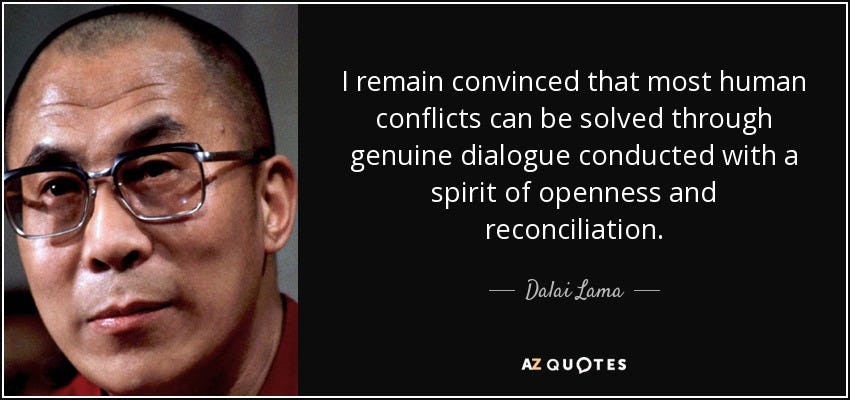
Reconciliation is never simple but it is always worth the effort required to achieve it.
Until we meet again,
Keep on taking the Good Roads in life.
Rich